For some children, learning to read feels almost impossible. They may be bright, curious, and eager to learn, yet continue to guess at words, read slowly, or avoid reading altogether. These difficulties are not a sign of low ability. They may point to dyslexia or another Reading Disability—and they call for more than extra practice. They call for the right instruction.
That is why we created the Science of Reading Center at Possibilities Clinic: to give struggling readers access to intensive, evidence-based intervention designed around what research tells us about reading, instruction, and the developing brain.
Reading researcher Dr. Jack Fletcher defines dyslexia by its central, observable features: difficulty reading and spelling single words accurately and fluently. Put simply, a learner may struggle to sound out an unfamiliar word, have difficulty recognizing a familiar word quickly, or spell words inaccurately. These word-level difficulties can become a bottleneck that affects reading fluency and comprehension—even when the learner understands complex ideas perfectly well when listening.
The Science of Reading is not a single program or passing trend. It is a large body of research from neuroscience, psychology, education, and linguistics. It shows that, unlike spoken language, reading does not develop naturally. The brain must learn to connect marks on a page with the sounds of speech, blend those sounds into words, and link words with meaning. For many learners—and especially those with dyslexia—these connections must be taught explicitly, systematically, and with enough repetition to become accurate and automatic.
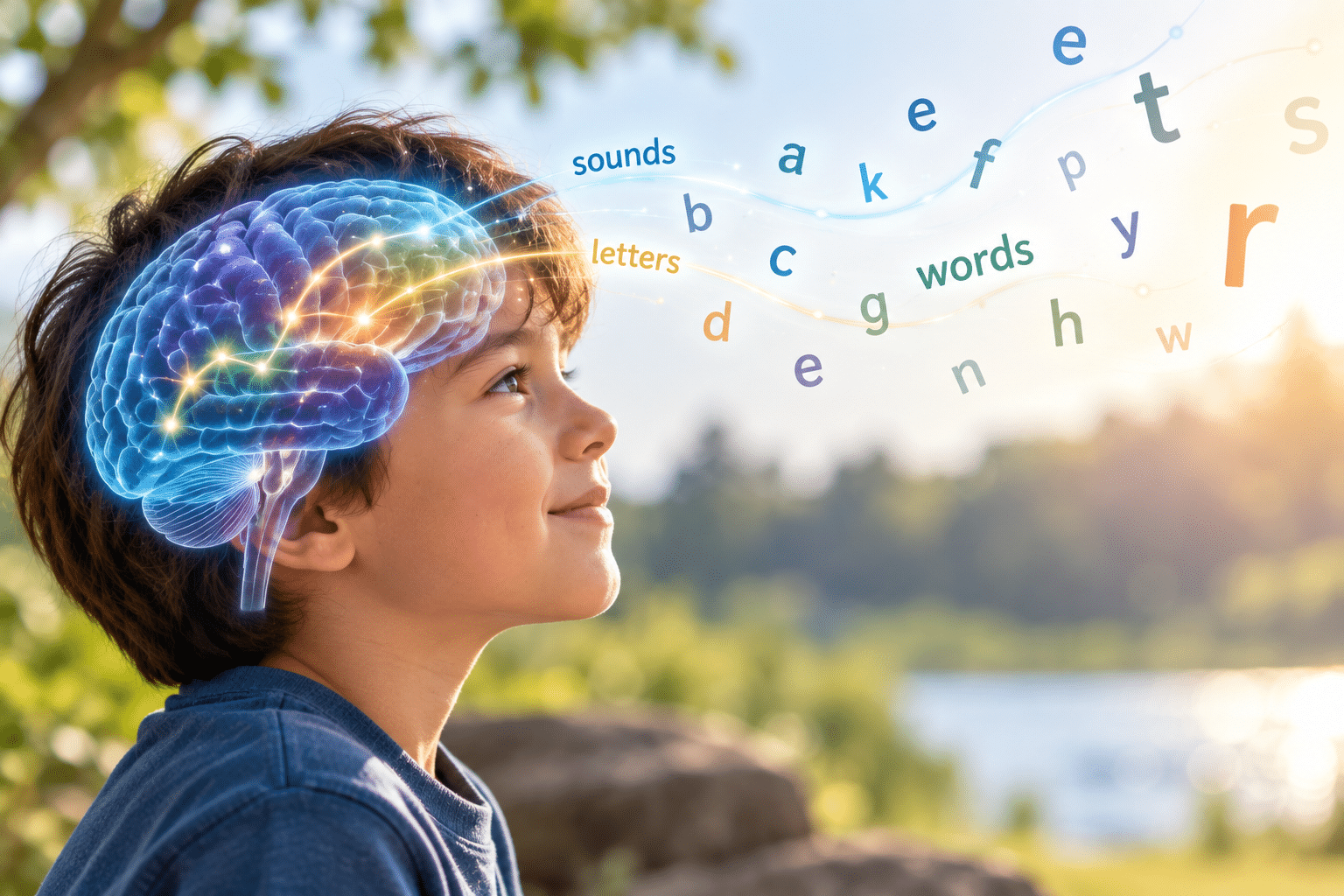
Brain research helps us see why this matters. Skilled reading depends heavily on networks in the left hemisphere. The posterior part of the left superior temporal gyrus helps connect print with speech sounds. In a landmark study co-authored by Fletcher, children with dyslexia initially showed little or no activation in this left-side region and greater activation in the corresponding area on the right—a sign that the brain was working hard to compensate. After 80 hours of intensive reading intervention, the children improved their reading and showed a dramatic increase in left superior temporal activation. Their brain activity began to look more like that of skilled readers.


The 80 hours reported in this study should not be interpreted as a universal amount of treatment. Every reader is different. Depending on factors such as age, attention, current reading level, the severity and duration of the reading difficulty, the frequency of instruction, and the child’s response to intervention, some children may require considerably more than 80 hours before showing significant change. Effective intervention is guided by the learner’s progress—not by a stopwatch or a predetermined finish line.
There is also no quick “brain-training” shortcut. Effective reading intervention must involve text. Students need direct teaching and practice in the skills reading actually requires: phonemic awareness connected to letters, decoding, word recognition, spelling, fluency, vocabulary, and comprehension. Instruction must be carefully sequenced, responsive to the learner, and intensive enough to make a measurable difference.
At the Possibilities Science of Reading Center, trained instructors provide individualized, one-to-one intervention using programs and methods supported by research. A formal, scientifically-supported program called Direct Instruction (DI) forms the foundation of our programming, complemented by Orton-Gillingham–based strategies. Lessons are explicit, structured, active, and mastery focused. We monitor progress continuously, because effective intervention is not simply a program delivered—it is instruction adjusted according to how the learner responds.
Families across Canada can access our reading intervention virtually with well-trained instructors. For families residing in Ontario, there is also an option to have progress monitored by a Clinical Paediatric Neuropsychologist. This added oversight can be especially valuable when reading difficulties occur alongside ADHD, anxiety, or a more complex learning profile. A diagnosis is not required to begin; placement testing helps us identify a learner’s starting point and build an appropriate plan.
Earlier support is ideal, but it is never too late. Children, adolescents, and adults can all strengthen their reading skills. With evidence-based teaching, sufficient intensity, and close progress monitoring, reading can improve—and the circuits supporting reading can change. That is the possibility at the heart of our new Center.
Warning Signs Worth a Closer Look
A child may benefit from further screening or assessment if they:
- Guess words using the first letter, general shape, picture, or context.
- Substitute a similar-looking word instead of sounding out the word on the page.
- Have difficulty blending sounds in unfamiliar words.
- Read slowly, laboriously, or without developing greater ease over time.
- Avoid reading aloud or become unusually tired or frustrated when reading.
- Spell common words inconsistently or continue to make frequent spelling errors.
- Understand stories read aloud but struggle to read the same material independently.
- Continue to have significant word-reading or fluency difficulties in Grade 3 or beyond.
- Receive a B, C, or D in foundational reading skills in Grades 1 or 2—especially when progress is slow or reading requires extraordinary effort.
Report-card grades alone do not identify dyslexia. Grading systems vary, and an overall language grade may combine reading with listening comprehension, participation, writing, or other strengths. Even a B in Language may deserve a closer look when a young child is guessing, struggling to sound out words, or working exceptionally hard to keep up. The goal is not to label a child based on a grade—it is to examine foundational skills early rather than waiting for the gap to grow.